Home | Services | Transmissions | Accessories | Engines | Diffs | Testimonials | Gallery | Links | Contact
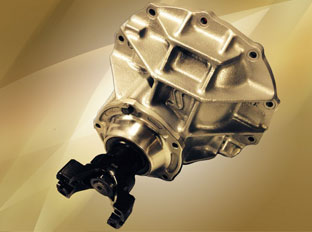
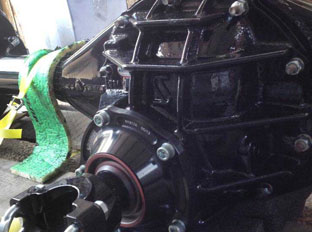
Many people can be unclear of 1stly what the purpose is for a cars differential.
The differential has three jobs:
• To aim the engine power at the wheels
• To act as the final gear reduction in the vehicle, slowing the rotational speed of the transmission one final time before it hits the wheels
• To transmit the power to the wheels while allowing them to rotate at different speeds (This is the one that earned the differential its name).
Car wheels spin at different speeds, especially when turning. You can see from the animation that each wheel travels a different distance through the turn, and that the inside wheels travel a shorter distance than the outside wheels. Since speed is equal to the distance travelled divided by the time it takes to go that distance, the wheels that travel a shorter distance travel at a lower speed. Also note that the front wheels travel a different distance than the rear wheels.
For the non-driven wheels on your car -- the front wheels on a rear-wheel drive car, the back wheels on a front-wheel drive car -- this is not an issue. There is no connection between them, so they spin independently. But the driven wheels are linked together so that a single engine and transmission can turn both wheels. If your car did not have a differential, the wheels would have to be locked together, forced to spin at the same speed. This would make turning difficult and hard on your car: For the car to be able to turn, one tire would have to slip. With modern tires and concrete roads, a great deal of force is required to make a tire slip. That force would have to be transmitted through the axle from one
wheel to another, putting a heavy strain on the axle components.
In drag racing applications, straight line, or dirt track, it either does not matter due to no turning, or slippage can occur on the loose surface. As such a full spool is used.
Most people running performance street vehicles have had the misfortune to break either axles or a centre and once you start combining high horse power with big tyres, the inevitable occurs. The added stress is usually too much for the stock rear axle assembly.
Although it is not infallible, the 9 inch Ford rear end assembly is becoming increasingly popular because of its versatility, combining brute strength and light weight with the added benefit of a removable third member for ease of set-up and maintenance.
With a 9 inch there is an endless supply of combinations to suit your specific needs, like different centres such as; Limited Slip (LSD), True Trac, Minispool, Fullspool, Locker and Open centres, and a gear ratio selection from aftermarket sources that would cover every combination your car would require. Street gear ratios are offered in 2.75, 3.0, 3.25, 3.5, 3.7, and 3.9, while race cars would use 4.1, 4.5, 5.1, 5.4, 5.6, 5.8, 6.0, 6.2 and 6.5! No other heavy duty rear end in Australia can offer a selection like that.
Although not necessary for street use, the 9 inch can be offered with even beefier parts, like 31 or 35 spline axles, double rib carriers, thick pinion supports, Detroit locker hemispheres, or even the 'N' carrier, a high strength item made from nodular iron that was original equipment fitted to the XY GTHO Falcons.
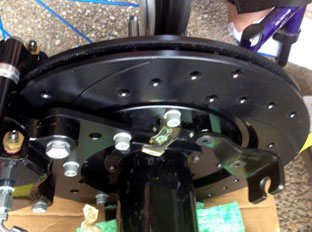
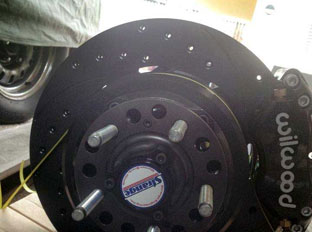
Basically, most 9 inch Ford diff conversions will only require a tail shaft modification to fit, but sometimes, sway bars may have to be alerted. Wherever possible, standard brake systems off your own vehicle are retained along with standard width. Disc brake conversions are not out of the question. So before you break anymore parts maybe it's time to consider changing to a 9 inch , with the right set of gears, you can unlock your cars true potential.
See the technical info for the secret ingredient for building a correct 9 inch differential.
Other Retail/Importing parts
TransMatt has close links to key retailers and importers in the USA. Most of the hard and soft parts come from the USA and can be imported either by air freight or surface mail, dependant on your timeframe for your project build.