Home | Services | Transmissions | Accessories | Engines | Diffs | Testimonials | Gallery | Links | Contact
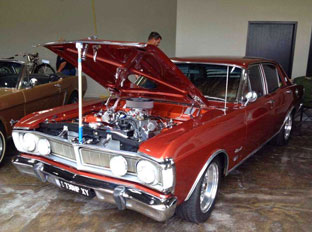
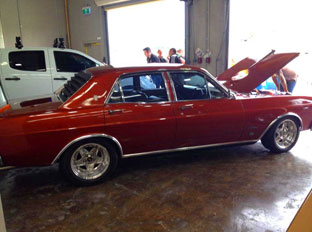
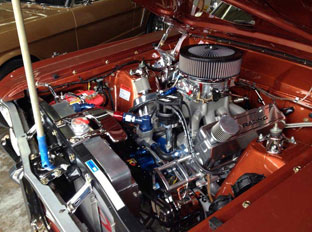
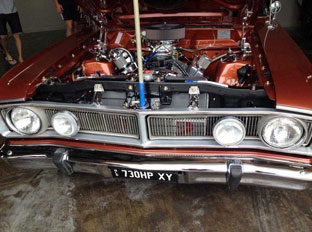
Three areas make an engine: Cubic capacity, Compression, Camshaft
Stroker kits/block size makes cubic capacity or (CC) or (CID) Cubic Inch Displacement.
TransMatt retails both Eagle and Scat Stroker kits, preferencing Scat as an excellent place to start and engine build. Combinations range far and wide so the best first place to start is to consider what you want your car and engine to do. Some streeters want midrange power, street and strip want higher end power levels and for the weekend worrier, sometimes just a little lift from stock is all that's required. With a stock application crank and rods need not be replaced, simply assess machine undersize and linish. Rings and bearings then complete a rotating assembly.
However to build (CC) or (CID) crankshaft, rods and pistons are selected for the best combination of rotating assembly. This is where important engine maths comes into play, every application is different. An engine could then become much more than an Aussie 308 or 5 litre engine.
To complete a short engine, oil pump, shaft, and other oiling systems are completed. Furthermore timing chain, sprockets and camshaft are selected. Camshaft is always a very important decision and should be very carefully considered. Many variables come into play during camshaft choosing. Again the big question is what is it that you want your engine to do? Then work backwards.
The higher an engine builds in its cubic capacity, the greater torque it will generate, as such the more fuel it will require, as such greater flowing cylinders heads will add value. (VE) or volumetric efficiency will determine air flow, air flow in addition to adding fuel will create a greater internal combustion, finally more power generated from your engine.
Naturally aspirated, or forced induction?
Naturally aspirated is an engine naturally sucking air into the engine and mixing with fuel, creating internal combustion.
Forced induction in through the use of either a turbo charger, utilising exhaust to push air into the engine, or a supercharger driving belts and pulleys and turbines to create a consistent push of air, more air and more fuel equals more power.
Two commonly used forced-induction compressors are turbochargers and superchargers. A turbocharger is a centrifugal compressor driven by the flow of exhaust gasses. Superchargers can be found as different types of compressors but are all powered directly by the rotation of the engine, usually through a belt drive. The compressor can be centrifugal or a roots type for positive displacement compression. An example of an internal compressor is a screw-type supercharger or a piston compressor.
A turbocharger relies on the volume and velocity of exhaust gases to spin (spool) the turbine wheel, which is connected to the compressor wheel via a common shaft. The boost pressure produced can be regulated by a system of release valves and electronic controllers. The chief benefit of a turbocharger is that it consumes less power from the engine than a supercharger; the main drawback is that engine response suffers greatly because it takes time for the turbocharger to come up to speed (spool up). This delay in power delivery is referred to as turbo lag. Any given turbo design is inherently one of compromise; a smaller turbo will spool quickly and deliver full boost pressure at low engine speeds, but boost pressure will suffer at high engine RPM. A larger turbo, on the other hand, will provide improved high-rev performance at the expense of low-end response. Other common design issues include limited turbine lifespan, due to the high exhaust temperatures it must withstand, and the restrictive effect the turbine has upon exhaust flow.
Superchargers have almost no lag time to build pressure because the compressor is always spinning proportionally to the engine speed. They are not as common as turbochargers because they use the torque produced from the engine to operate. This results in some loss in power and efficiency. A Roots-type supercharger uses paddles on two rotating drums to push air into the intake. Because it is a positive displacement device, this compressor has the advantage of producing the same pressure ratio at any engine speed. A screw-type supercharger is also a positive displacement device, like a Roots-type supercharger. Screw-type superchargers are more complex to manufacture than Roots-type superchargers, but are more efficient to operate, producing cooler air output. A centrifugal-type supercharger is not a positive displacement device and will usually have better thermal efficiency than a Roots-type supercharger. Centrifugal superchargers are also more compact and easier to use with an intercooler.
After a short engine, heads and induction are added; final items complete a turn key engine. These items include carburettor, or fuel injection, ignition/distributor, spark plugs and leads.
Fuel system
Fuel pump and fuel regulator
Fuel lines
Fuel tank